

Authors: Darshan H. Brahmbhatt, Fernando Luis Scolari, Nicole L. Fung, Madison Otsuki, Patrick R. Lawler, Heather J. Ross, Uros Kuzmanov, Anthony O. Gramolini, Adriana C. Luk, Filio Billia
Short Description: Cardiogenic shock (CS) is the most severe form of acute heart failure (HF) characterized by severely reduced cardiac output and inadequate end-organ perfusion leading to tissue hypoxia. Patients with CS suffer significant morbidity and mortality1 with in-hospital mortality reaching up to 50%.2 The pathophysiological underpinnings of CS remain to be fully elucidated, but inflammation is thought to play a key role.3 One of the several potential mechanisms for worsening of the shock state has been proposed to occur through the release of inducible nitric oxide and its mediators, resulting in inappropriate vasodilatation.4 Additionally, the development of systemic inflammatory response syndrome (SIRS) is seen in up to a third of patients at presentation and portends a more severe clinical syndrome associated with worse outcomes.5
The inflammatory profile associated with CS is now being studied in greater detail. However, the majority of studies have focused on CS following acute myocardial infarction (AMI-CS). In AMI-CS, an acute ischaemic insult leads to an immediate drop in cardiac output, which may then be compounded by the ischaemia–reperfusion injury associated with acute revascularization.6 In contrast to this, CS caused by acute decompensated HF (ADHF-CS) often has a heterogeneous trajectory, even before presentation. This realization is important in that these patients may have a different clinical profile and outcomes after discharge.7 The HF state has its own heightened inflammatory state, which is also known to affect outcomes.8 Thus far, the inflammatory profile of patients with ADHF-CS has not been fully characterized nor has the transition from a clinically stable, outpatient-managed HF state to ADHF-CS, and it is unclear if there are changes in the inflammatory profile that occur during this clinical deterioration.
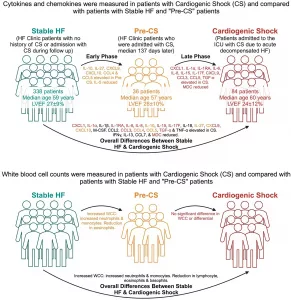
This retrospective, cross-sectional study was designed to investigate the profile and prognostic significance of circulating cytokines and cellular inflammatory profiles in patients with ADHF-CS admitted to a cardiac intensive care unit (CICU) and to define the association between circulating cytokines in outpatients with HF and those admitted with CS.
Interest: cardiogenic shock, heart failure, cytokines, mechanical circulatory support, biomarkers, chemokines