Vascular

2025 | Heart Failure Decompensation with Cardiogenic Shock Exhibits Distinct Sequential Inflammatory Profiles

150 150 fraser.amos@uhn.ca

Authors: Darshan H. Brahmbhatt, Fernando Luis Scolari, Nicole L. Fung, Madison Otsuki, Patrick R. Lawler, Heather J. Ross, Uros Kuzmanov, Anthony O. Gramolini, Adriana C. Luk, Filio Billia

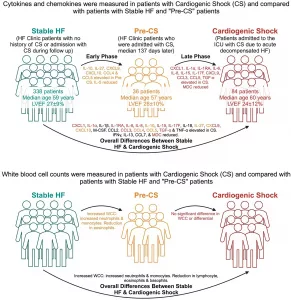
Short Description: Cardiogenic shock (CS) is the most severe form of acute heart failure (HF) characterized by severely reduced cardiac output and inadequate end-organ perfusion leading to tissue hypoxia. Patients with CS suffer significant morbidity and mortality1 with in-hospital mortality reaching up to 50%.2 The pathophysiological underpinnings of CS remain to be fully elucidated, but inflammation is thought to play a key role.3 One of the several potential mechanisms for worsening of the shock state has been proposed to occur through the release of inducible nitric oxide and its mediators, resulting in inappropriate vasodilatation.4 Additionally, the development of systemic inflammatory response syndrome (SIRS) is seen in up to a third of patients at presentation and portends a more severe clinical syndrome associated with worse outcomes.5

The inflammatory profile associated with CS is now being studied in greater detail. However, the majority of studies have focused on CS following acute myocardial infarction (AMI-CS). In AMI-CS, an acute ischaemic insult leads to an immediate drop in cardiac output, which may then be compounded by the ischaemia–reperfusion injury associated with acute revascularization.6 In contrast to this, CS caused by acute decompensated HF (ADHF-CS) often has a heterogeneous trajectory, even before presentation. This realization is important in that these patients may have a different clinical profile and outcomes after discharge.7 The HF state has its own heightened inflammatory state, which is also known to affect outcomes.8 Thus far, the inflammatory profile of patients with ADHF-CS has not been fully characterized nor has the transition from a clinically stable, outpatient-managed HF state to ADHF-CS, and it is unclear if there are changes in the inflammatory profile that occur during this clinical deterioration.

This retrospective, cross-sectional study was designed to investigate the profile and prognostic significance of circulating cytokines and cellular inflammatory profiles in patients with ADHF-CS admitted to a cardiac intensive care unit (CICU) and to define the association between circulating cytokines in outpatients with HF and those admitted with CS.

Interest: cardiogenic shock, heart failure, cytokines, mechanical circulatory support, biomarkers, chemokines
Click Here to Read the Full Publication

2025 | Pretreatment Circulating Vascular Biomarkers Predict Cancer Therapy-Related Cardiac Dysfunction During HER2+ Breast Cancer Treatment

150 150 fraser.amos@uhn.ca

Authors: Dakota Gustafson, Priya Mistry, Crizza Ching, Inbar Nardi-Agmon, Christopher Yu, Chun-Po Steve Fan, Christian Houbois, Eitan Amir, Thomas Marwick, Husam Abdel-Qadir, Chris McIntosh, Paaladinesh Thavendiranathan, Jason E Fish

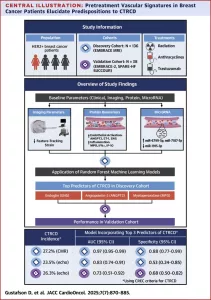
Short Description:Blood biomarkers to predict cancer therapy-related cardiac dysfunction (CTRCD) risk remain limited. The aim of this study was to identify circulating biomarkers associated with CTRCD risk in HER2+ breast cancer patients. Pretreatment endothelial-centric and inflammatory biomarkers outperformed both clinical and CMR measures in predicting CTRCD during chemotherapy.

Interest: angiopoeitin-2, biomarkers; breast cancer; cancer therapy–related cardiac dysfunction; cardio-oncology; endothelium; inflammation; machine learning; microRNA; myeloperoxidase; vascular

Click Here to Read the Full Publication

2025 | Multiomic Landscape of Extracellular Vesicles in Human Carotid Atherosclerotic Plaque Reveals Endothelial Communication Networks

150 150 fraser.amos@uhn.ca

Authors: Sneha Raju, Mandy E. Turner, Christian Cao, Majed Abdul-Samad, Neil Punwasi, Mark C. Blaser, Rachel M.E. Cahalane, Steven R. Botts, Kamalben Prajapati, Sarvatit Patel, Ruilin Wu, Dakota Gustafson, Natalie J. Galant, Lindsey Fiddes, Melody Chemaly, Ulf Hedin, Ljubica Matic, Michael A. Seidman, Vallijah Subasri, Sasha A. Singh, Elena Aikawa, Jason E. Fish, and Kathryn L. Howe

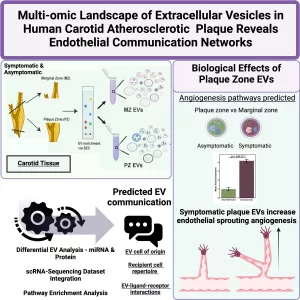
Short Description: Carotid atherosclerosis is orchestrated by cell-cell communication that drives progression along a clinical continuum (asymptomatic to symptomatic). Extracellular vesicles (EVs) are cell-derived nanoparticles representing a new paradigm in cellular communication. Little is known about their biological cargo, cellular origin/destination, and functional roles in human atherosclerotic plaque.

Our findings indicate that EVs may drive dynamic changes in plaques through EV–vascular cell communication and effector functions that typify vulnerability to rupture, precipitating symptomatic disease. The discovery of endothelial-directed angiogenic processes mediated by EVs creates new therapeutic avenues for atherosclerosis.

Interest: Arteriosclerosis, Thrombosis, and Vascular Biology

Click Here to Read the Full Publication

2022 | Cardiovascular Signatures of COVID-19 Predict Mortality and Identify Barrier Stabilizing Therapies

150 150 admpmccbiobank

Authors: Dakota Gustafson, Michelle Ngai, Ruilin Wu, Huayun Hou, Alice Schoffel, Clara Erice, Serena Mandla, Filio Billia, Michael D. Wilson, Milica Radisic, Eddy Fan, Uriel Trahtemberg, Andrew Baker, Chris McIntosh, Chun-Po S. Fan, Claudia C. dos Santons, Kevin C. Kain, Kate Hanneman, Paaladinesh Thavendiranathan, Jason E. Fish, Kathryn L. Howe

Short Description: Endothelial cell (EC) activation, endotheliitis, vascular permeability, and thrombosis have been observed in patients with severe COVID-19, indicating that the vasculature is affected during the acute stages of SARS-CoV-2 infection. Results from this study indicated that multiple inflammatory and EC activation biomarkers were associated with mortality in COVID-19 patients and in severity-matched SARS-CoV-2-negative patients, while dysregulation of specific microRNAs at presentation was specific for poor COVID-19-related outcomes and revealed disease-relevant pathways.

Interest: COVID-19, Respiratory Disease, Stroke and Cardiovascular, Vascular

Click Here to Read the Full Publication

Privacy Preferences

When you visit our website, it may store information through your browser from specific services, usually in the form of cookies. Here you can change your Privacy preferences. It is worth noting that blocking some types of cookies may impact your experience on our website and the services we are able to offer.

Click to enable/disable Google Analytics tracking code.
Click to enable/disable Google Fonts.
Click to enable/disable Google Maps.
Click to enable/disable video embeds.
Our website uses cookies, mainly from 3rd party services. Define your Privacy Preferences and/or agree to our use of cookies.