

2025 | Multiomic Landscape of Extracellular Vesicles in Human Carotid Atherosclerotic Plaque Reveals Endothelial Communication Networks
https://pmccbiobank.ca/wp-content/themes/osmosis/images/empty/thumbnail.jpg 150 150 fraser.amos@uhn.ca fraser.amos@uhn.ca https://secure.gravatar.com/avatar/4700def0819703d34d07e41db7e99c3af5d01396f322703ebefce3c89a1de6e3?s=96&d=mm&r=g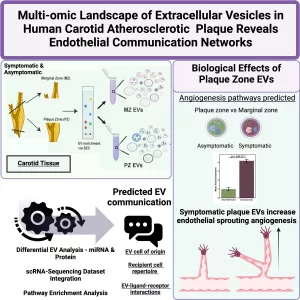
Authors: Sneha Raju, Mandy E. Turner, Christian Cao, Majed Abdul-Samad, Neil Punwasi, Mark C. Blaser, Rachel M.E. Cahalane, Steven R. Botts, Kamalben Prajapati, Sarvatit Patel, Ruilin Wu, Dakota Gustafson, Natalie J. Galant, Lindsey Fiddes, Melody Chemaly, Ulf Hedin, Ljubica Matic, Michael A. Seidman, Vallijah Subasri, Sasha A. Singh, Elena Aikawa, Jason E. Fish, and Kathryn L. Howe
Short Description: Carotid atherosclerosis is orchestrated by cell-cell communication that drives progression along a clinical continuum (asymptomatic to symptomatic). Extracellular vesicles (EVs) are cell-derived nanoparticles representing a new paradigm in cellular communication. Little is known about their biological cargo, cellular origin/destination, and functional roles in human atherosclerotic plaque.
Our findings indicate that EVs may drive dynamic changes in plaques through EV–vascular cell communication and effector functions that typify vulnerability to rupture, precipitating symptomatic disease. The discovery of endothelial-directed angiogenic processes mediated by EVs creates new therapeutic avenues for atherosclerosis.
Interest: Arteriosclerosis, Thrombosis, and Vascular Biology