COVID-19

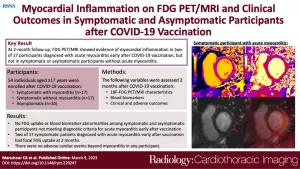
    2023| Myocardial Inflammation at FDG PET/MRI and Clinical Outcomes in Symptomatic and Asymptomatic Participants after COVID-19 Vaccination

    150 150 fraser.amos@uhn.ca

    Authors: Constantin Arndt Marschner, Paaladinesh Thavendiranathan, Dakota Gustafson, Kathryn L. Howe, Jason E. Fish, Robert M. Iwanochko, Rachel M. Wald, Husam Abdel-Qadir, Slava Epelman, Angela M. Cheung, Rachel Hong, Kate Hanneman

    Short Description: As of August 2022, more than 5.3 billion people worldwide have received at least one dose of a COVID-19 vaccine (1). Several adverse events have been reported, including myocarditis and pericarditis, following the administration of mRNA-based COVID-19 vaccines (2,3). The overall incidence of myopericarditis following COVID-19 vaccines is low, estimated at 18 per 1 million vaccine doses, with the highest risk in adolescent and young adult males (4). However, many more patients experience cardiac symptoms after vaccination, including shortness of breath, palpitations, and chest pain, yet do not meet diagnostic criteria for acute myopericarditis (5). The cause of these symptoms and the natural history of these patients remains unknown.

    Cardiac MRI plays an important role in the assessment of myocardial tissue changes (6). Cardiac fluorine 18 (18F) fluorodeoxyglucose (FDG) PET provides complementary physiologic information, allowing for the assessment of changes in myocardial metabolism (7,8). Several recent case series have reported cardiac MRI findings in patients with myocarditis following COVID-19 vaccination (9,10). However, there are limited data on patients who present with new-onset cardiac symptoms following COVID-19 vaccination but do not meet diagnostic criteria for myopericarditis (5). There are also limited data evaluating potential subclinical myocardial tissue changes in asymptomatic individuals after vaccination.

    The purpose of this study was to identify cardiac sequelae of COVID-19 vaccination and relate patient-reported cardiac symptoms to myocardial tissue changes identified with cardiac FDG PET/MRI, circulating biomarkers of cardiac injury and systemic inflammation, health-related quality of life, and adverse cardiac events at 2-month follow-up. Our goal was to inform guidelines for cardiac investigations after COVID-19 vaccination and the potential need for longer-term follow-up.

    Interest: Myocardial Inflammation, COVID-19, Vaccination, Molecular Imaging, MR Imaging
    Click Here to Read the Full Publication

    2020| Anti-Thrombotic Therapy to Ameliorate Complications of COVID-19 (ATTACC): Study Design and Methodology for an International, Adaptive Bayesian Randomized Controlled Trial

    150 150 fraser.amos@uhn.ca

    Authors: Brett L Houston, Patrick R Lawler, Ewan C Goligher, Michael E Farkouh, Charlotte Bradbury, Marc Carrier, Vlad Dzavik, Dean A Fergusson, Robert A Fowler, Jean-Phillippe Galanaud, Peter L Gross, Emily G McDonald, Mansoor Husain, Susan R Kahn, Anand Kumar, John Marshall, Srinivas Murthy, Arthur S Slutsky, Alexis F Turgeon, Scott M Berry, Robert S Rosenson, Jorge Escobedo, Jose C Nicolau, Lindsay Bond, Bridget-Anne Kirwan, Sophie de Brouwer, Ryan Zarychanski

    Short Description: Mortality from COVID-19 is high among hospitalized patients and effective therapeutics are lacking. Hypercoagulability, thrombosis and hyperinflammation occur in COVID-19 and may contribute to severe complications. Therapeutic anticoagulation may improve clinical outcomes through anti-thrombotic, anti-inflammatory and anti-viral mechanisms. Our primary objective is to evaluate whether therapeutic-dose anticoagulation with low-molecular-weight heparin or unfractionated heparin prevents mechanical ventilation and/or death in patients hospitalized with COVID-19 compared to usual care.

    Interest: Anti-thrombotic therapy, COVID-19, cardiac injury, venous thromboembolism, myocardial infarction, ischemic stroke

    Click Here to Read the Full Publication

    2022 | Cardiovascular Signatures of COVID-19 Predict Mortality and Identify Barrier Stabilizing Therapies

    150 150 admpmccbiobank

    Authors: Dakota Gustafson, Michelle Ngai, Ruilin Wu, Huayun Hou, Alice Schoffel, Clara Erice, Serena Mandla, Filio Billia, Michael D. Wilson, Milica Radisic, Eddy Fan, Uriel Trahtemberg, Andrew Baker, Chris McIntosh, Chun-Po S. Fan, Claudia C. dos Santons, Kevin C. Kain, Kate Hanneman, Paaladinesh Thavendiranathan, Jason E. Fish, Kathryn L. Howe

    Short Description: Endothelial cell (EC) activation, endotheliitis, vascular permeability, and thrombosis have been observed in patients with severe COVID-19, indicating that the vasculature is affected during the acute stages of SARS-CoV-2 infection. Results from this study indicated that multiple inflammatory and EC activation biomarkers were associated with mortality in COVID-19 patients and in severity-matched SARS-CoV-2-negative patients, while dysregulation of specific microRNAs at presentation was specific for poor COVID-19-related outcomes and revealed disease-relevant pathways.

    Interest: COVID-19, Respiratory Disease, Stroke and Cardiovascular, Vascular

    Click Here to Read the Full Publication

    2022 | Combined Cardiac Fluorodeoxyglucose-Positron Emission Tomography/Magnetic Resonance Imaging Assessment of Myocardial Injury in Patients Who Recently Recovered From COVID-19

    150 150 admpmccbiobank

    Authors: Kate Hanneman, Christian Houbois, Alice Schoffel, Dakota Gustafson, Robert M. Iwanochko, Bernd J. Wintersperger, Rosanna Chan, Jason E. Fish, Kathryn L. Howe, Paaladinesh Thavendiranathan

    Short Description: There is limited understanding of changes with myocardial metabolism in patients who have recovered from acute COVID-19. In this paper, we examine myocardial metabolic changes early after recovery from COVID-19 using fluorodeoxyglucose-positron emission tomography (PET) and associate these changes to abnormalities in cardiac magnetic resonance imaging (MRI)-based function and tissue characterization measures and inflammatory blood markers.

    Interest: Cardiac Imaging, COVID-19, Medical Imaging, Myocardial Injury, Respiratory Disease

    Click Here to Read the Full Publication

    Privacy Preferences

    When you visit our website, it may store information through your browser from specific services, usually in the form of cookies. Here you can change your Privacy preferences. It is worth noting that blocking some types of cookies may impact your experience on our website and the services we are able to offer.

    Click to enable/disable Google Analytics tracking code.
    Click to enable/disable Google Fonts.
    Click to enable/disable Google Maps.
    Click to enable/disable video embeds.
    Our website uses cookies, mainly from 3rd party services. Define your Privacy Preferences and/or agree to our use of cookies.